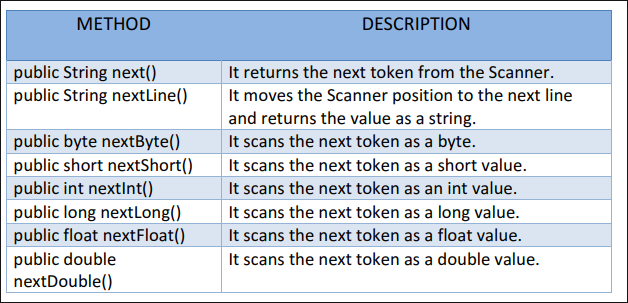
commonly used scanner
Being good at DSA should mean that you are good at use data structures and algorithms to solve a problem in most
optimal way possible .
It is usefull as it increases the thinking ability of a human to solve a problem in the
given resources / utilizing the given resources to meet the requirements and also have a good performance.
This page teaches you - I wouldn't say all - but something that would be enough to last a human life time |
In order to get better at programming logics I use OOPs as well |
learn shell scripting BTW , it drastically
increases your programming power |
what is shell scripting ? , bruh are you using windows [buhahaha , That's
what few linux user would say but, I am different I do like windows for what it is - if someone wants something else
they can have something else. What I meant was - are you using buttons ? I am still unemployed and I might also be
able to give interviews to microsoft so I guess I shouldn't stay stuff like that .No offence to windows I wanted
to say / I meant GUI . BTW imagine - me an arch linux user giving interview to microsoft, I really like windows - its
good and stuff , Its support to run certain executables is the best feature like games . And there are other good
things like security , anti virus features etc.]?
To make the learning the way it has to be and not by some outdated types like sitting in a room and just using pen
paper - I introduce the idea of shinobi ranking ,
You have to compete studying through one level to reach a level
/ unlock a level that's above it - obv there are no restrictions / constraints - it is just a convention - if you
cheat , you still know where you stand |
passing level would be if you understood everything till the level of a
KAGE
Java is platform independent and hence its class files can be circulated across machines without tampering
Beginner![WARNING] Though JDK is convert those class executables into machine code . A higher lower version of JDK cannot convert a .class file into machine code that was compiled by a higher version of JDK
JDK = JRE+Compiler+docs
JRE contains JVM
| datatype | size on ram |
|---|---|
| short | 2 bytes |
| int | 4 bytes |
| long | 8 bytes |
| byte | 1 byte |
| flaoting | points |
| double | 8 bytes [higher precision] |
| float | 4 bytes |
| characters | |
| char | 2 bytes [c takes 1 byte - minimal mahn] |
| boolean | typically 1 bit |
Narrowing conversion the upper one - explicitly declare it , if you want the conversion , else just show it in
desired form while printing (char)a where a is an int
int i=0;
    float p=i;
int i=0;
    char p=i;
int i=0;
    char p=(char)i
operatorPrecendenceJava
moregraphical
scanner
commonly used scanner
#include<stdio.h>

int main(){
int a=10;
if(a>0){
int b=20;
}

printf("%d\n%d",a,b);
}

/ document the practise problem that is the patterns ones and etc in some squid game manner like how the pink soldiers ask for square or triangle etc....
int a=10;
int b=2;

System.out.println(a&b);
System.out.println(a|b);
System.out.println(a^b);
System.out.println(~a);// "~" this is the complement operator
System.out.println(a << 2); // left shift by 2 raised to 2 , as it is converted into binary that is
essentailly "a*(2**2)". <br> For ex - 6 << 2 is
// 6 - 0000110
// 2 left shifts makes - 0011000 = 24
// which is 6*(2**2), 6*4=24
System.out.println(a >> 2); // right shift i.e. -4
Convert the values of variables to binary then perform the specified operations and you will get the result.
Make
use of few properties such as : a^a=0, since all the bits are same
a^0=a.
Pratise this for better understanding of loops
++i , increments before using i
i++ , increments later
mostly usefull in print statements
since
if you do
i=5;
    i++;
    // [or] ++i;
    printf("%d",i);
    // There will be no change
in for loops
initialises the var , no matter what. The first value of the var is the value initialised in the parameters of the loop [cuz point 4]
checks the condition ; if true goes into the body
executes the body
now performs what ever opetaion is mentioned in the for loop
goes to step 2
![NOTE] the comparision step in a for loop is done n+1, the last time is for the rejection take the following as an example:
int i=1;
for(;i<n;i++)
System.out.println(i);// this prints till 5
System.out.println(i); // this prints till 6 , cuz i++ , i got incremented but rejected by the condition step ,
though it is still a function variable and not a loop variable , the trace is kept by the function and the
incremented value is printed
int a=60,b=80;

if(a++ >60 && b++ > 80 ){
System.out.println("Inside if");
}
else{
System.out.println("Inside else");
}

System.out.println("a: "+a+" "+"b: "+b);
Inside else
    a: 61 b:80
since a is incremented after being processed 60 is not > 60 so inside else
logical operators uses short-circuit
and hence since first part is taken as not true the remaining part is unnecessary to evaluate and hence skips that
part - which essentially skips the part where b is incremented and b remains 80!
public static void increment(int n){
n++
}

// in main

increment(n);

// n won't increment since n's value is passes and not n itself and hence n's value is incremented and
not n , to be more precise the local varible of the increment function was incremented
The fix to this is by using pointers in C
public static int sum(int a, int b){
return a+b;
}
public static double sum(int a, int b){// not possible , same parameters are already defined in another function of
the same name
return a+b;// though if this was the only function make sure to pass int to it and it will return the double
}
public static int sum(int a){ // works
return a;
}
LINEAR DATA | NON LINEAR DATA